
No Contact?
What a Genogram Can Teach Us About Family Estrangement


If you have ever pulled away from a family member or been on the receiving end of someone else’s silence, you are not alone. Maybe it was a slow drift, or maybe it came quickly on the tails of an election. Either way, it can feel confusing, painful, and deeply personal.
Here’s the thing: family cutoffs are not rare. They are common. And these days, people are finally talking about them out loud.
There is a phrase you’ve probably heard online: “going no contact.” It’s become a way for people—especially trauma survivors and adult children of dysfunctional families—to say, I have tried everything. I am done.
Unlike past generations, where cutoffs often happened quietly and without explanation, today’s no-contact decisions are more conscious and sometimes even public. People are naming it, posting about it, finding support groups and solidarity online. I want to explore this a bit here with you for a few very important reasons.
First, emotional cutoffs are signal that we need more relational skill. Equally important, is that the way we navigate emotional cut-off can affect romantic relationships and personal well-being for a very long time. Finally, inter-generational transmission can occur where we inadvertently model a way of handling family connection to our children. This should be well-considered as part of our process to avoid handing down a legacy of dysfunction.
Please hear me clearly. Sometimes we need to protect ourselves from harmful people.
In future posts, I will talk more about how to decide if going no-contact is necessary for you. We also will talk about how to acquire skills of well-shored boundaries. There are no hard rules here, but I’ll do my best to provide guidelines to frame your process.
Bowenian Theory
Murray Bowen, the founder of aptly named, Bowen Family Systems Theory, introduced the concept of emotional cutoffs in the late 70’s. For Bowen, one of our core emotional jobs is the differentation of self from the family system.
Family systems hold an incredible amount of anxiety about the differentiation process. On my daily dog walk, there is large home where 3 black Cadillac Escalades are proudly parked in the driveway. They are different model years, but essentially the same car. What are the odds that these are highly individuated folks?
The anxiety around differentiation is why cut-offs occur around things like:
changing religious identity or becoming an atheist or agnostic
sexual identity
political affiliation
moving out of a hometown, home state, or country
biracial marriage
choosing a career
not having children
giving up your royal title (shout out to Harry & Meghan and Edward VII and Wallis.)
A healthy goal is high differentiation, or the ability to maintain my emotional reactions to family members, while avoiding avoidance. Terry Real, a famous family therapist (whom I may or may not be a groupie), calls this place, Protected AND Connected.

Step 1: Gaining Perspective
If you are in conflict right now, it might feel counter-intuitive to step back from the immediate problem. However, when we take a minute to step back we often gain perspective on why and how we ended up entangled.
This is called “meta-cognition” or the ability to think about one's own thinking processes, observing and analyzing one's own thoughts, actions, and motivations from an external or objective perspective. Here we are talking about ourselves within a family system so we could call it “systemic meta-cognition” but that may be parsing too much. Sometimes I think of it as the 14,107 feet view. (I see you, Tava Mountain.)
Whatever you wanna call it, the extended perspective is valuable to our understanding. And to gain this view, we will use a genogram. A genogram is like a family tree, but with depth. It does not just map who is related to who. It shows how people relate.
Who’s close?
Who’s distant?
Where’s the tension?
Where did the silence begin?
You might discover that your parents also cut off a sibling or that your grandparents refused contact with certain relatives. These aren’t isolated incidents. They are part of a family system’s adaptive strategy for emotional pain.
Take Barack Obama’s family genogram, for example.
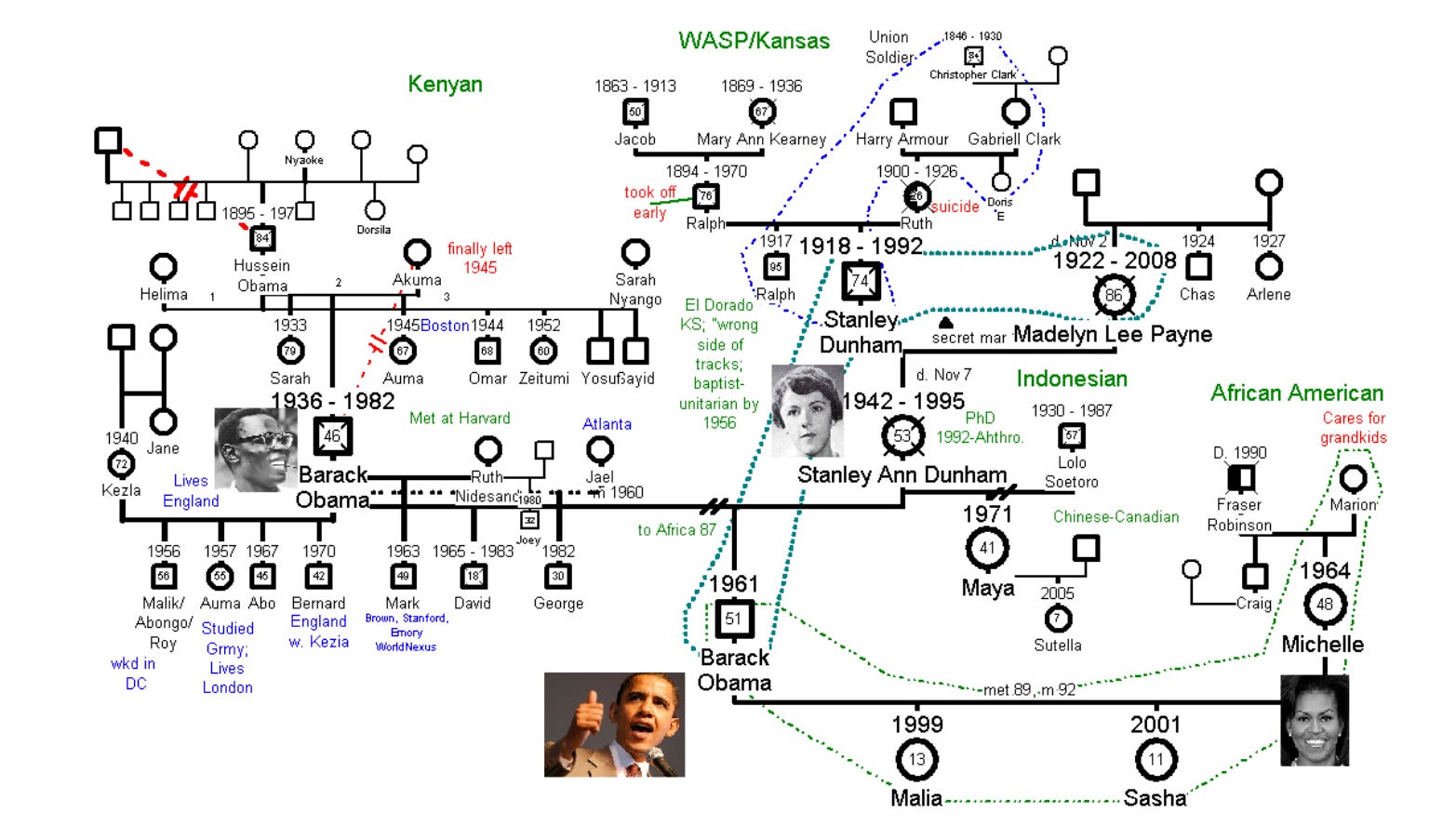
His story includes:
Parents divorcing early
A father he barely saw again
A mix of cultures, expectations, and silence
See the red lines? Those represent emotional cut-offs.
🔨 The Work This Week
Start your genogram
This is your map. Your chance to look at patterns of connection, silence, and cutoff across generations.
Here's how:
Draw your family genogram (at least 3 generations if you can).
Add emotional connections: close, strained, cutoff.
Look for patterns: Who disappears? Who becomes the peacemaker? Who holds the resentment?
Download the Genogram and Symbols Worksheet PDF here: The Work-Genogram
It includes a robust symbol key (you don’t have to use them all) and journaling prompts to help you process what you see.
If you complete The WORK, send me a message- nina@ninadippon.com
More from Bowen Center.. a little dry but some jewels in it.
Coming Next Week:
Boundaries 101.